You’ve Been Using AI Without a Compliance Framework. That’s a Problem.
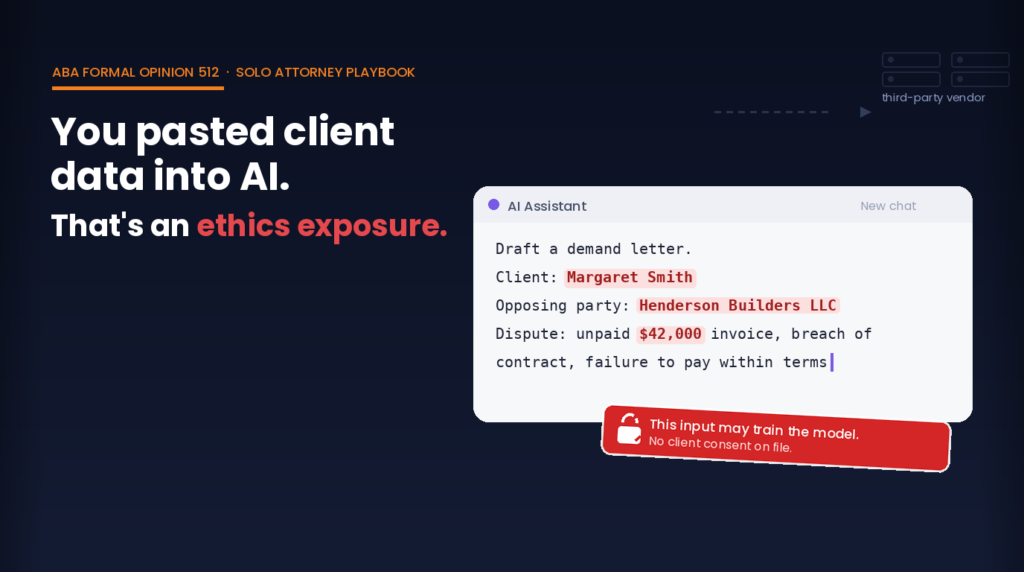
You opened ChatGPT to draft a demand letter. Pasted in the client’s name, the opposing party, a summary of the dispute. Solid first draft in 90 seconds.
You didn’t read the terms of service. You didn’t check whether your input trains the model. Your engagement letter says nothing about AI. Your client never consented to a third-party vendor processing their information.
That’s not a workflow choice. That’s an ethics exposure.
As an ABA Opinion 512 solo attorney, navigating these rules requires a clear strategy. The Model Rules already apply to AI tools—competence, confidentiality, supervision, and fee obligations don’t change.
This post covers exactly what an ABA Opinion 512 solo attorney needs to know to remain compliant, where solos are getting it wrong, and what to fix this week.
What an ABA Opinion 512 Solo Attorney Must Understand
Opinion 512 doesn’t ban AI. It requires you to understand the tools you use, verify all outputs before relying on them, and protect client confidentiality at every step. If a tool could expose client information to a third party, you need informed consent first. You’re responsible for anyone using AI under your supervision. Billing must reflect actual work performed — not time the tool saved. Responsibility stays with you.
The 5 Duties. What They Require. What You’re Getting Wrong.
Competence (Rule 1.1)
What the rule requires. You must understand the tools you use — not the code, not the architecture. How they work, where they fail, and what risks they introduce to your practice.
What solos are getting wrong. Most attorneys treat AI like a search engine — reliable unless something looks off. It isn’t. AI produces confident, fluent, completely wrong output. Hallucinated citations are the most documented failure, but the same problem applies to contract clauses, legal standards, and case summaries. Claiming you didn’t know the tool was unreliable is not a defense. The New Hampshire Bar is explicit: Ignorance of the technology doesn’t satisfy the competence standard, meaning an ABA Opinion 512 solo attorney must actively vet their tech stack.
What to do this week. Test your tool on a matter you know well. Ask a specific legal question. Verify every claim it makes. Note where it’s wrong. That’s your verification baseline. Write it down. Use it every time.
Confidentiality (Rule 1.6)
What the rule requires. You must protect all client information. That obligation doesn’t pause when you open an AI prompt.
What solos are getting wrong. The most common mistake: entering client names, case facts, and dispute details into free, general-purpose tools like ChatGPT or Google Gemini. Many of these tools use inputs to improve their models depending on account settings. Your client’s data may be retained, processed, and reused in ways they never agreed to. The risk is contractual — it’s in the terms of service you didn’t read.
What to do this week. Pull up the terms and privacy policy for every AI tool you currently use. Look specifically for language on training data, input retention, and deletion. If the terms are unclear or unfavorable, switch to a tool with enterprise-grade protections or stop entering client information until you have informed consent. When you must use a general-purpose tool, strip all PII from every prompt — names, identifying details, jurisdiction-specific facts, anything connecting the input to a real client or matter.
Supervision (Rules 5.1 and 5.3)
What the rule requires. You’re responsible for every output that leaves your practice — whether it came from staff, a contractor, or an AI tool. Rules 5.1 and 5.3 don’t distinguish between a paralegal and software. Work product for a client or a court is yours. That line is why our tools do arithmetic and never judgement: the court date calculator counts days on rules you enter and confirm, and never decides which rule applies.
What solos are getting wrong. Two failures. First: a paralegal uses AI without a firm policy in place, enters client data into a free tool, generates a draft, and hands it to you. You file it without knowing how it was created. Still your problem. Second: a quick read-through is not supervision. That’s skimming.
What to do this week. Write a one-page AI use policy. Cover which tools are approved, what data can and cannot be entered, what verification steps are required before any output is used, and who is accountable. One page. This week. If anyone other than you uses AI in your practice without this in writing, you have a supervision gap.
Communication and Informed Consent (Rules 1.4 and 1.6)
What the rule requires. If your AI use could expose client information to a third party, you need informed consent — not a vague disclaimer. Opinion 512 requires explaining why you’re using AI, what the risks are, what safeguards you have, and that the client has a real choice to decline.
What solos are getting wrong. Most engagement letters say nothing about AI or include a line like “We may use technology to assist with your matter.” That doesn’t meet the standard. Vague language isn’t informed consent. It communicates nothing.
What to do this week. Add a specific AI disclosure clause to your engagement letter before your next AI-assisted matter. The next section shows exactly what that language should look like.
Fees (Rule 1.5)
What the rule requires. Fees must be reasonable. A task that used to take two hours and now takes 20 minutes with AI is not a two-hour billing item. You charge for work performed — not what it would have cost without the tool.
What solos are getting wrong. The most common quiet mistake: AI drafts a contract in 15 minutes, the attorney bills three hours because “that’s what it used to take.” That’s an overcharge — not a gray area. There’s also a classification problem. Many solos bill AI tool costs to clients as disbursements. General-purpose tools like ChatGPT, Copilot, and Gemini are overhead. You don’t bill clients for your internet connection. Same principle.
What to do this week. Pull three recent matters where you used AI. Compare what you billed to how long the work actually took. Find the gap. Adjust. The rule is simple: bill for time spent prompting, reviewing, editing, and verifying — not for time the tool saved.
What “Informed Consent” Looks Like
Informed consent is a conversation, not a clause.
The clause in your engagement letter opens the door. For matters with significant AI use — or where a client has raised data privacy concerns — informed consent means a real explanation: what tool you’re using, what information may be processed, what the vendor’s data practices are, and what you’re doing to limit exposure. Document it.
Here’s workable plain-English language for your engagement letter:
Use of Artificial Intelligence To handle your matter efficiently, I may use AI tools for research and drafting. These tools are provided by third parties and may require inputting case-related information. There is a risk that this data could be accessed by the vendor or retained for their purposes. I will review all AI-generated content for accuracy and limit sensitive data exposure where possible. You may choose not to allow AI use in connection with your matter. Please let me know your preference.
That language does three things: explains the tool, discloses the risk, and gives the client a real choice.
Generic language that fits any tool and any matter isn’t informed consent. It’s plausible deniability. Those aren’t the same thing.
AI Vendor Due Diligence Checklist
Before using any AI tool in your practice, get answers to these questions:
- Data training: Does the vendor use your inputs to train or improve their model? Is there an opt-out?
- Data retention: How long is your data stored? Where? Under what conditions?
- Deletion policy: Can you request deletion? Does the vendor confirm it?
- Security: What encryption and access controls are in place? Is the infrastructure compliant with relevant data security standards?
- Breach notification: What is the vendor’s process if there’s a breach? What recourse do you have?
- Conflict risk: Could information from one matter surface in outputs for another?
- Vendor accountability: Is there a data processing agreement that creates a legal obligation on the vendor’s part?
If you can’t answer most of these for a tool you’re currently using, stop using it for client matters until you can.
New Hampshire Bar Overlay
The New Hampshire Bar’s AI guidance aligns with ABA Opinion 512 and adds two points worth noting.
First, New Hampshire applies stricter caution to AI use in client-specific drafting. A quick read-through isn’t enough. Every claim, citation, and legal conclusion in a client deliverable needs independent verification.
Second, the guidance addresses bias and fairness risks. AI reflects biases in its training data. In matters involving sentencing, custody, immigration, or employment, that’s not abstract — it’s a reason to apply additional scrutiny.
The practical position: meet the ABA floor, but use New Hampshire’s stricter verification and prompting standards as your operational baseline.
What Solo Attorneys Are Getting Wrong Right Now
Specific mistakes. Not hypotheticals.
Using free AI tools with client data. Consumer AI tools aren’t built for legal confidentiality. Their terms often permit training on user inputs. Most attorneys using these tools haven’t read those terms.
Engagement letters with no AI disclosure. If your template hasn’t been updated in the past year, it almost certainly has no AI clause. That’s not a minor gap — it’s a failure of informed consent.
No verification process. Trusting AI output because it looks right isn’t verification. Verification means independently checking every citation, legal standard, and factual claim before anything leaves your desk.
Billing for time AI saved. If AI cut a four-hour task to 45 minutes, you bill 45 minutes. Billing the prior rate is an overcharge.
No AI policy for staff or contractors. If someone working for you uses AI on your matters without written guidance, you have a supervision failure — regardless of whether anything has gone wrong yet.
Treating competence as one-time. One CLE on AI doesn’t close the competence obligation. These tools change. The risk landscape changes. Your understanding has to keep pace.
ABA Opinion 512 Is Not a Ban. It’s a Floor.
Opinion 512 doesn’t say you can’t use AI. It says you can’t use it carelessly.
The same duties governing your client files, paralegal supervision, and fee calculations apply to every AI tool in your practice. The technology is new. The obligations aren’t.
The floor: understand what you’re using, verify what it produces, protect client information, get consent when required, bill fairly, supervise everyone working under you.
Everything above that floor is competitive advantage. Attorneys who build a real compliance framework can use AI confidently and at scale. Attorneys who skip it are accumulating risk they can’t see.
Compliance isn’t the obstacle to using AI well. It’s what makes AI use sustainable.
You don’t need to overhaul your practice at once. Close the most exposed gaps first.
Start here. This week.
- Audit the terms of service for every AI tool you’re currently using.
- Update your engagement letter with a plain-English AI disclosure.
- Write a one-page AI use policy for anyone working with you.
- Build a verification checklist. Apply it to every AI-assisted output before it leaves your desk.
- Review three recent billing items that involved AI. Adjust your practices going forward.
The exposure is real. The fixes aren’t complicated. Most take under an hour.
If you want a compliance-aware starting point, LegalContext is built for solo attorneys and small firms — legal workflows and confidentiality requirements included from the start.
Not sure where your biggest gap is? Take the free Practice Operations Assessment. Under 10 minutes. It identifies specific compliance risks in your current setup before they become a problem.
Take the Practice Operations Assessment
FAQ
Does ABA Opinion 512 mean I can’t use ChatGPT? No. It means you must understand how ChatGPT handles your data, verify everything it produces, and obtain informed consent before entering client information. If your current setup doesn’t meet those conditions, fix it or switch tools.
What counts as a compliant AI disclosure in an engagement letter? It must explain what types of tools you use, what data risks exist, what safeguards you apply, and that the client can opt out. Vague language doesn’t meet the standard. Be specific.
Do I need consent every time I use AI, or just once? If your engagement letter includes a properly written disclosure and the client has signed it, you don’t need separate consent for each task. If the tools or scope change materially, revisit the disclosure.
How should I bill for AI-assisted work? Bill for actual time spent — prompting, reviewing, editing, verifying. Not for time the tool saved. If the task took 30 minutes, bill 30 minutes.
What if my paralegal uses AI without my knowledge? You’re still responsible. Rules 5.1 and 5.3 require supervisory structures — not just good intentions. Put a written AI use policy in place before it becomes a problem.